Her discoveries
Beneath the stone lie traces of a forgotten world... prodigious creatures that had never been seen before.
Ichthyosaur
In 1811, on the cliffs of Lyme Regis, Mary Anning made an extraordinary discovery: a huge fossilized marine reptile dating from the Jurassic period, nearly six meters long.
Following the death of her brother Joseph, she had resumed the excavations. During these searches, she identified the skull and, after several months of effort, exhumed the almost complete skeleton of an unknown creature.
For several months, Mary returned to the cliffs, where she carefully uncovered an exceptional skeleton. After months of work, she brought to light an almost complete skeleton, several meters long.
This exceptional fossil reveals a prehistoric marine animal that propels itself and swims. A true sea monster that lived millions of years ago. Her discovery fascinates.
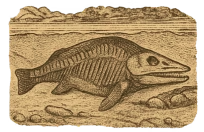
This extraordinary marine reptile revolutionized scientific knowledge: it demonstrated the existence of species that had disappeared millions of years ago. For a long time, the scientific community questioned: the men who studied it sometimes doubted its authenticity.
But Mary, confident in her work, guided her visitors each time: she showed them the ichthyosaur. After verification, Cuvier finally admitted his error: the ichthyosaur was indeed real.
At 12 years old, Mary Anning thus discovered one of the first known complete fossil species. This historic discovery of a Mesozoic marine reptile. In doing so, she revealed to the world a prehistoric species of capital importance and inscribed her name at the heart of the incredible history of paleontology.
Plesiosaur
In 1823, more than a decade after the discovery of the ichthyosaur, Mary Anning made a new fascinating discovery: the fossil of another marine reptile, unknown.
On the cliffs of Lyme Regis, always on the lookout for fossil clues, she came across a skeleton of a prehistoric creature resembling a sea serpent: a head, long vertebrae and an endless neck.
For months, she labored to patiently uncover the limestone plates... and found the remains of an absolutely extraordinary animal: the plesiosaur, a marine reptile with a long neck and enormous flippers.
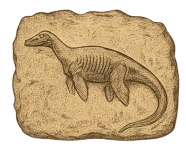
This discovery is so extraordinary that some scientists at the time saw it as a hoax! Never before had such a fossil animal been found. When she presented it, reactions varied.
But Mary, confident in her work, guided her visitors. The plesiosaur is authentic.
Thanks to this fossil, we began to understand how much prehistoric oceans harbored radically different life forms.
After verification, her discovery was eventually recognized as official: she succeeded in revealing an unknown species and, through this work, she enabled the discovery and better understanding of the incredible history of paleontology.
Pterodactyl
In 1828, as she once again walked the cliffs of Lyme Regis, Mary Anning made an astonishing discovery: the fossil of a pterodactyl, the first found in England.
Among the cliff sediments, she distinguished a series of bones from a strange flying creature: a reptile with membranous wings, capable of gliding through the air – nothing comparable to what she had found before.
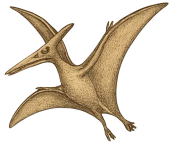
Intrigued, she continued her excavations with her characteristic meticulousness. Little by little, she uncovered an almost complete skeleton of this enigmatic animal. Its membranous wings, its very elongated beak, everything indicated a flying creature of a hitherto unknown kind: a flying reptile from the Mesozoic, a creature that soared through the skies millions of years ago.
Once again, her discovery caused a sensation, but her name remained in the shadow of the men of science who plagiarized her.
This discovery once again confirms her precise gaze and ability. She is a woman who, despite obstacles, managed to identify an unknown species and contribute decisively to our knowledge of prehistoric life. Mary Anning proves that she is an essential member of science: she reveals the secrets of the past, one stone at a time.